
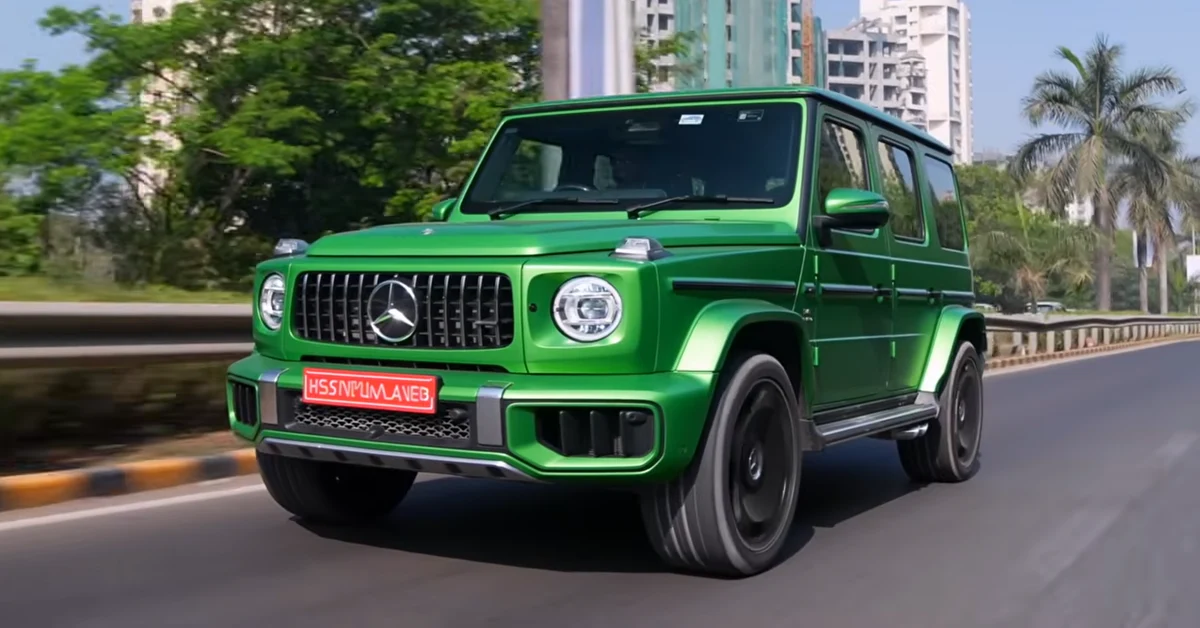
There are cars you buy with your head, and there are cars you buy with your heart. The Mercedes G63 AMG is firmly, unapologetically, in the second category — and it doesn’t care what your head thinks about it.
Few vehicles in automotive history have managed to stay relevant for decades without a complete reinvention. The G-Class has. With its instantly recognisable boxy silhouette, exposed door hinges, and round headlamps that look borrowed from a different era, this is a car that refuses to grow up — and that’s exactly why people love it.
But love, as they say, has its complications. So let’s talk about the full picture: what makes the G63 AMG genuinely special, and where it falls flat.
The Not-So-Pretty Side
Mercedes G63 AMG Price in India: Is It Worth ₹4.6 Crore?

Let’s start with the elephant in the room. The Mercedes G63 AMG is priced at around ₹4.6 crore on-road in Mumbai, making it the most expensive Mercedes you can currently buy in India — more than any Maybach or AMG model in the lineup. For context, back in 2019, the G350D launched at ₹2 crore. Today’s updated version, same generation, costs ₹3.5 crore. That’s a 75% increase in seven years.
Much of this comes down to import duties, since the G-Class is a CBU (completely built unit). There’s genuine hope that the India-EU Free Trade Agreement, once fully in effect, will significantly lower prices. Until then, owning one means paying a premium that goes well beyond the car itself.
Mercedes G63 AMG Missing features at a price that should have them all

Given what you’re spending, you’d expect every box to be ticked. And yet — no head-up display, no panoramic sunroof with an electric blind, no rear seat ventilation or sunblind’s, and touch-sensitive steering wheel controls instead of proper physical buttons.
The ADAS system is another quirk. Every time you restart the car, it resets itself back on — unlike newer Mercedes models where your preferences are remembered. On Indian roads, where driving conditions are chaotic and unpredictable, the system fires off forward collision warnings constantly, occasionally triggering automatic emergency braking at the worst moments. You have to manually disable it every single time you start the car. At this price, that’s a genuinely frustrating oversight.
The rear seat doesn’t quite earn its space
For a vehicle that stretches beyond 4.8 meters in length with a wheelbase of nearly 2.9 meters, the rear cabin experience is surprisingly average. Legroom and knee room are tighter than you’d expect, climbing in requires some effort given the high seat position, and you never quite settle into the generous space the exterior promises. Headroom is fine, but overall it feels like the G-Wagon’s proportions were designed for presence, not passenger comfort.
Read Also – BYD Seal U: The Plug-In Hybrid SUV That Finally Solves India’s EV Anxiety
The ride: honest, but unforgiving
This is where the Mercedes G63 AMG’s heritage works against it on everyday Indian roads. The ladder-frame chassis — essential for its off-road capability — introduces a lumpy, jittery quality at lower speeds. The low-profile tyres transmit every imperfection directly into the cabin. There’s body roll, there’s stiffness, and while the adaptive dampers in Comfort mode do take some edge off, they don’t transform the experience the way air suspension would.
Speed things up and the ride settles, but city driving can feel like a workout. Bottom line: this is a car built for open roads. Our potholes aren’t its friend.
Now, the Reasons People Actually Buy It
Mercedes G63 AMG the design is in a category of its own
Nothing on the road looks like a G-Wagon. The boxy shape, the thali spare wheel mounted on the tailgate, the side-exit exhaust, the hood-mounted indicators (which apparently cost Mercedes considerably more than conventional ones) — it all adds up to something that turns heads everywhere it goes.

Step inside and the attention to detail continues. The grab handle on the co-passenger side has a quality that’s hard to describe — it just feels right. The door lock and unlock sounds are so satisfying they’ve become a signature of the car. LED lighting, logo projections from the door mirrors, red AMG brake calipers — it’s old-school wrapped in modern execution.
Built like nothing else on the road
You know how some expensive cars feel delicate, like you’re afraid to use them too hard? The G63 is the exact opposite. The doors can be slammed with real force and they close with a solidity that feels almost architectural. Everything about it suggests it was engineered to outlast the roads it drives on. This is a car that’s genuinely built to last.
Performance that makes no physical sense

A 4-litre twin-turbo V8 — the M177 — pushing 585 horsepower and 850 Nm of torque. Zero to 100 km/h in 4.3 seconds. In a vehicle shaped like a refrigerator. When you plant your foot, the rear squats, the nose lifts, and it just goes. It doesn’t feel like it should be physically possible, and that’s exactly why it’s so addictive.
A 48V mild hybrid system adds an extra 20 horsepower and 200 Nm for near-instant throttle response. A 9-speed dual-clutch gearbox shifts with impressive speed. The side-mounted exhaust means you hear every pop, crackle, and growl up close. Fuel economy sits around 3–5 km per liter, which is expected, and the 100-litre tank at least means fewer stops.
The steering, too, deserves a mention — it’s direct, weighted beautifully, and surprisingly communicative for something this large. Handling isn’t sporty in any conventional sense, but there’s a confidence to it that makes the G-Wagon feel composed even when you’re pushing it.
It’ll go places most cars can only imagine

Three locking differentials, 241 mm of ground clearance, and 700 mm of water wading depth. The G-Class was built for serious terrain, and even without adjustable air suspension, its mechanical capability is formidable. Press the differential lock buttons and very little can stop it.
The electric G-Class takes this further with four individual motors and genuine torque vectoring — including the party trick G-Turn, which lets it spin almost on the spot. Whichever variant you choose, off-road ability is a genuine strength across the entire G-Class family.
Bonus: The Mercedes G63 AMG feature list is longer than you’d expect
For all its old-school looks, the G63 is loaded. You get a 12.3-inch digital instrument cluster, a matching 12.3-inch infotainment display with physical controls, dual 11.6-inch rear entertainment screens, an 18-speaker 760W Burmaster 3D sound system, front seat heating, ventilation, and massage, 64-colour ambient lighting, a 360° camera, three-zone climate control with color-coded AC vents, heated and cooled cup holders, nine airbags, and even automated parking. For a vehicle that looks like it belongs in the 1980s, the tech inside is very much 2025.
Read Also – Skoda Kushaq Monte Carlo 2026: The Ultimate Upgrade with Exciting New Features and Enhanced Style
So, Is It Worth It?
That depends entirely on who you are. If you’re looking for the most sensible use of ₹4.6 crore, the G63 AMG will disappoint you. The ride isn’t comfortable enough, the rear seat isn’t spacious enough, and the features list has gaps that have no business existing at this price.
But if you want something iconic — a machine with genuine character, absurd performance, the ability to go anywhere, and a design that still stops traffic after four decades — there’s nothing quite like it. Demand consistently outstrips supply, which also makes it a surprisingly strong investment with excellent resale value.
The G63 AMG doesn’t try to be logical. That’s the whole point.
